
Interested, but not enrolled?

Phil Sims
AMHS and Gap Student Showcase
Something Old, Something New
Something Borrowed, Something Blue
Lento from the Etude in D Major, Op. 29 No. 21, "Study in Harmonics"
- composed by Fernando Sor (1778-1839)
- performed by Victor Lin Björnström, guitar
Broken Sky
- composed by Andrew York (b. 1958) and Agustin Amigó
- performed by Victor Lin Björnström and Stephen Pepper, guitar duet
24 Preludes, Op. 11 No. 1 in C Major - Vivace
- composed by Alexander Scriabin (1872-1915)
- performed by Sydney Martin, piano
Invention No. 14 in B-flat Major BWV 785
- composed by J.S. Bach (1685-1750)
- performed by Sydney Martin, piano
Waltz No. 19 in A Minor
- composed by Frédéric Chopin (1810-1849)
- performed by Sydney Martin, piano
French Suite No. 4 in E-flat Major, BWV 815 Allemande
- composed by J.S. Bach (1685-1750)
- performed by Metaxia Logotheti, piano
Piano Sonata No. 20 in G Major, Op. 49. No. 2
- Ludwig van Beethoven (1770-1827) Allegro
- Metaxia Logotheti, piano
Dolce desiderio, Op. 2: Romance in D-flat Major for Piano and Cello
- composed by Sydney Martin (b. 2007)
- performed by Sydney Martin, piano and Jenn Cornell, cello
Angels Talking (for solo electronics)
- by Clem Gainty (b. 2008)
How Heavenly to See the Sun
- Victor Lin Björnström (b. 2008)
- from Chasing a Sword Lily, album release January 2025
Man Up
- Whittaker Dallas (b. 2006)
Something New
- composed and performed by Metaxia Logotheti (b. 2007)
’Round Midnight
- Thelonious Monk (1917-1982)
- performed by Oscar Lin Björnström, tenor sax Peter Sloan, piano
Arrival Occurrence
- composed by the performing band members:
- Oscar Lin Björnström, tenor sax
- Victor Lin Björnström, guitar
- Lily Jones, bass
- Bennett Fogle, drums
Concorde Black County, New Road
- arranged by performing band members:
- Oscar Lin Björnström, tenor sax
- Victor Lin Björnström, guitar
- Lily Jones, bass
- Bennett Fogle, drums
- Peter Sloan, tambourine
School is Back: Set the Table
Hard to believe it, but school is here, and kids are back. Thank you for doing your best to make every student, parent and all your colleagues feel welcome. It takes us a few weeks to get everyone's schedule sorted out, so we appreciate your extra patience and flexibility the first few weeks. For a successful, productive year of learning and growing, routines are key. We'll get there, and we should be doing all we can now to make sure the kids are learning the ropes.
There are a couple of brands and places that stand out in my mind when I think of being welcoming. Danny Meyer, founder of one of NYC's Union Square Hospitality Group (one of the most successful and famous groups), wrote a great book about this called Setting the Table: the Transformational Power of Hospitality in Business. We experienced this first hand visiting many of his restaurants over the almost 10 year period our daughter was a chef in the group. I noticed this right away on my first visit to Gramercy Tavern, but what really got me was the next visit to another restaurant in the group. When I arrived and we were seated the waiter asked, "Mr. Sims would you like an Old Fashioned?" I chuckled and said, "yes, of course, it's my favorite drink." And she said, "with rye, right?" After a few more visits over the next year or two, it came to be that whenenever I visited one of the restaurants in the group, reservation or not, when I was taken to a table or counter, the table was set and there would be a fresh old fashioned with rye waiting for me. Come on, now. That's excellent hospitality marked by true caring.
There are too many pointers for this update, but you can imagine what prepping for dinner guests entails, and how that applies to wlecoming students, parents and colleagues. I always admired a couple of other places for setting the table- Disney, Chick-Fil-A (except for the Decatur location) and my alma mater, the Eastman School of Music.
I was stunned at Disney when the gardener picking up trash around a plant island saw us struggling with the map and sketching out our next few rides. He heard us debating and chimed in. He gave us a some good advice from the insider point of view and then pointed udsin the right direction. Above and beyond.
I had similar ipressions of Chick-Fil-A over the years, so I was surprised when I got eye rolls and sighing when I asked to exchange a box of soggy cold fries at that location by city hall. As for college, I was mesmerized by the audition, interview experience. There were solo and small ensembles tucked in every corner of the campus. The harpist crammed in one of the small, old elevators taking requests was unforgetably lovely. She and every one else we encountered made a simple point of saying something kind to every nervous kid and parent, something like, "good luck," or "don't sweat it, you'd going to be great," or "just be the best you you can." It was calming and reassuring to have people acknowledge our nerve and to remind us to enjoy the experience and to stay focused.
A couple of practical points or action items
- Safety first. Always.
- Please greet everyone you meet
- Diana is the go to for schedule questions
- If something is off, seems odd or iffy, please or needs admin attention, please speak up
We love our CMC team. We're looking forward to fun and hard work with all of you. LEt's be our best selves-- welcoming, encouraging, honest and helpful.
-Phil
Gaming Music & Sound Workshop
Gear Heads
Intro to pedals and computer interface
Strings Now Weekend Workshop
Sample Schedule
- 8-9AM Drop Off/Arrival
- 9-9:45AM - Intro/Performance (Lead Instructor -Jenn Cornell will present a looping performance including an overview of her sound equipment, 6-String Electric Cello and multiple effects pedals and discuss her perspectives on how to find a unique voice of musical freedom within the structure of music and the use of technology.)
- 10-11- Extended Techniques Workshop (harmonics, color change/distortion, hammer on and pull offs, unconventional plucking, slides, power chords, and percussive techniques)
- 11:15AM Music Theory Basics/Ear Training (Overview of Scales, Key Signatures, Circle of Fifths, Chords and Intervals. Goal: to bring more awareness to how we listen to and perform music. Class will include listening exercises, descriptive writing exercises and creative drawing.)
- 12-1PM Lunch
- 1PM- Improv Basics (Pentatonic scale, 12-Bar Blues/Chord Progressions, Finding your voice)
- 2PM- Personal practice time of Extended Techniques and Improv with 12 part blues backing track (Student will need their own personal device for playing track from Youtube)
- 3PM- Pickup
Workshop Performance
- Sunday, July 28 2:00 pm @ CMC Decatur
Gear Heads
Intro to pedals and computer interface
Old Time/Folk & Songwriting Performance Workshop
ATL Mass Brass
/>
The ATL Mass Brass Workshops will be held at Atlanta Music High School. We're offering two workshops this summer.
- middle school students are invited to attend workshop the week of June 3-8, 2019
- High school students and college undergraduates are invited to attend workshop the week of June 24-29, 2019.
Trumpet, horn, trombone, euphonium, and tuba players are welcome.
The ATL Mass Brass Workshop is a locally unique camp that immerses brass players in both solo and ensemble music making with peers and a faculty comprised of professional performers and educators. Students will spend the week rehearsing as participants in several different brass ensembles, including daily rehearsals and coaching in brass quintet, like-instrument ensembles (such as trombone or trumpet choir) and a large, mass brass ensemble. Students will also have the opportunity to work on solo repertoire with accompanists. The ATL Mass Brass Workshop also includes private lessons with faculty specialists. The week culminates in a Saturday morning concert by students.
Gaming Music & Sound Workshop
Summer Performance Workshop - Decatur Camp
The CMC Atlanta Summer Performance Workshop provides middle and high school students (including recent graduates) the opportunity to play music they love with peers and faculty. With an emphasis on small ensemble performance (rock band, jazz combo, etc.), students can choose to perform just about any style of music, including jazz, rock, folk, country, American roots, hip hop and more.
The Summer Performance Workshop is open to both singers and instrumentalists, and individual students can rotate between different roles in the ad hoc and standing ensembles we create in the Performance Workshop.
Students can attend Full Day (9 to 4 pm) or Half Day morning (9-12:30).
Workshop includes:
- small ensemble rehearsal and performance
- group music theory classes to cultivate literacy, understanding of scales, chords, and keys
- classes on harmony and song design for more advanced students
- private coaching on primary instrument or in vocal performance for singers
Guitar Rookie ' decatur
A week long morning only half day camp for students with just a little or no experience playing the guitar. The camp covers the fundamentals and supports students with tools to start playing in any style. With enrollment capped at 8-10 students maximum, students receive individual attention in a relaxed and friendly environment. Students get playing and learn practice strategies and keys to developing piano skills. Camp includes small group lessons, privates lessons, theory and musicianship training, and an intro to playing piano in duet or mixed small ensemble.
Guitar Rookie
A week long morning only half day camp for students with just a little or no experience playing the guitar. The camp covers the fundamentals and supports students with tools to start playing in any style. With enrollment capped at 8-10 students maximum, students receive individual attention in a relaxed and friendly environment. Students get playing and learn practice strategies and keys to developing piano skills. Camp includes small group lessons, privates lessons, theory and musicianship training, and an intro to playing piano in duet or mixed small ensemble.
Piano Rookie 2 - Inman Park
A week long morning only half day camp for beginner or near beginner piano students. The camp covers the fundamentals and supports students with tools to start playing music in any style. With enrollment capped at 8-10 students maximum, students receive individual attention an support in a relaxed and friendly environment. Students get playing and learn practice strategies and keys to developing piano skills. Camp includes small group lessons, privates lessons, theory and musicianship training, and an intro to playing piano in duet or mixed small ensemble.
Piano Rookie - Decatur
A week long morning only half day camp for beginner or near beginner piano students. The camp covers the fundamentals and supports students with tools to start playing music in any style. With enrollment capped at 8-10 students maximum, students receive individual attention an support in a relaxed and friendly environment. Students get playing and learn practice strategies and keys to developing piano skills. Camp includes small group lessons, private lessons, theory and musicianship training, and an intro to playing piano in duet or mixed small ensemble.
Gear Heads
Intro to pedals and computer interface
Gear Heads
Intro to pedals and computer interface
Guitar Rookie - Inman Park
A week long morning only half day camp for students with just a little or no experience playing the guitar. The camp covers the fundamentals and supports students with tools to start playing in any style. With enrollment capped at 8-10 students maximum, students receive individual attention in a relaxed and friendly environment. Students get playing and learn practice strategies and keys to developing piano skills. Camp includes small group lessons, privates lessons, theory and musicianship training, and an intro to playing piano in duet or mixed small ensemble.
Studio 5 Production Workshop
Strings Now Weekday Camp
Tiger Guitar
Tigers: fast, loud, colorful, impressive.
Designed for advanced high school and undergraduate students, Tiger Guitar is a week of piano master classes, theory and musicianship classes, and one on one private lessons with CMC Atlanta faculty and guest faculty. Meet and interact with other serious players. Festival ends with a recital by advanced students.
Tiger Piano Workshop/Festival
Tigers: fast, loud, colorful, impressive.
Designed for advanced high school and undergraduate students, Tiger Piano is a week of piano master classes, theory and musicianship classes, and one on one private lessons with CMC Atlanta faculty and guest faculty. Meet and interact with other serious players. Festival ends with a recital by advanced students.
Piano Rookie - Inman Park
A week long morning only half day camp for beginner or near beginner piano students. The camp covers the fundamentals and supports students with tools to start playing music in any style. With enrollment capped at 8-10 students maximum, students receive individual attention an support in a relaxed and friendly environment. Students get playing and learn practice strategies and keys to developing piano skills. Camp includes small group lessons, privates lessons, theory and musicianship training, and an intro to playing piano in duet or mixed small ensemble.
Summer Performance Workshop - L5P/Inman Park Camp
The CMC Atlanta Summer Performance Workshop provides middle and high school students (including recent graduates) the opportunity to play music they love with peers and faculty. With an emphasis on small ensemble performance (rock band, jazz combo, etc.), students can choose to perform just about any style of music, including jazz, rock, folk, country, American roots, hip hop and more.
The Summer Performance Workshop is open to both singers and instrumentalists, and individual students can rotate between different roles in the ad hoc and standing ensembles we create in the Performance Workshop.
Students can attend Full Day (9 to 4 pm) or Half Day morning (9-12:30).
Workshop includes:
- small ensemble rehearsal and performance
- group music theory classes to cultivate literacy, understanding of scales, chords, and keys
- classes on harmony and song design for more advanced students
- private coaching on primary instrument or in vocal performance for singers
We design and run our Performance Workshop using the same values, goals, and principles that have made our programs popular with parents and students alike:
- we group students by age, skill level, and interests
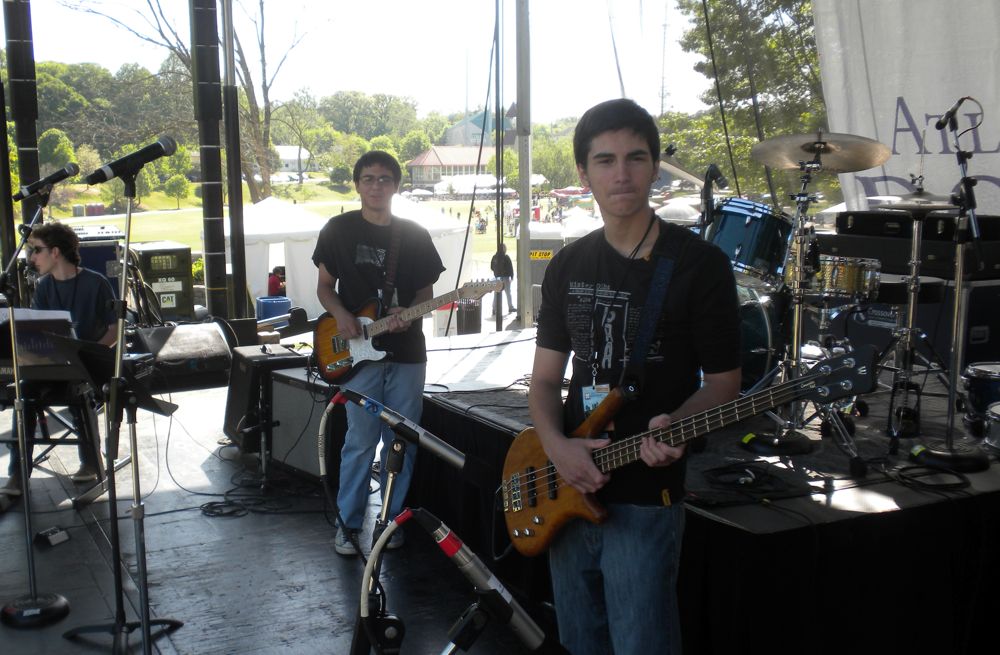
- we understand discipline as a tool for reaching goals, but emphasize experiential learning and we keep it fun
- we analyze and respond well to differentiated learning styles and different musical goals,
- we limit enrollment so the students receive individual attention, and most importantly,
- we empower students to take control of their own creative output.
Best of all, our Performance Workshops are staffed by our professional team of expert faculty and camp counselors, and tuition is very reasonably priced.
Strings Now Weekend Workshop
Sample Schedule
- 8-9AM Drop Off/Arrival
- 9-9:45AM - Intro/Performance (Lead Instructor -Jenn Cornell will present a looping performance including an overview of her sound equipment, 6-String Electric Cello and multiple effects pedals and discuss her perspectives on how to find a unique voice of musical freedom within the structure of music and the use of technology.)
- 10-11- Extended Techniques Workshop (harmonics, color change/distortion, hammer on and pull offs, unconventional plucking, slides, power chords, and percussive techniques)
- 11:15AM Music Theory Basics/Ear Training (Overview of Scales, Key Signatures, Circle of Fifths, Chords and Intervals. Goal: to bring more awareness to how we listen to and perform music. Class will include listening exercises, descriptive writing exercises and creative drawing.)
- 12-1PM Lunch
- 1PM- Improv Basics (Pentatonic scale, 12-Bar Blues/Chord Progressions, Finding your voice)
- 2PM- Personal practice time of Extended Techniques and Improv with 12 part blues backing track (Student will need their own personal device for playing track from Youtube)
- 3PM- Pickup
Workshop Performance
- Sunday, July 28 2:00 pm @ CMC Decatur
Gaming Music Camp 2 - Decatur
Gaming Music Camp - Inman Park
Snow Aster

Phil Sims
Phil Sims studied music at the undergraduate and graduate level at the Eastman School of Music in Rochester, NY. He has held academic appointments to teach theory, musicianship, composition, and electronic music at the Eastman School of Music, the University of Rochester, Mercer University, and Emory University. In recent years, Phil’s creative work has mainly focused on the creation of albums and sound design scores using a mix of acoustic and virtual instruments. His compositions have been performed and presented throughout the country and in Europe, in both academic and community venues, most recently at the Schwartz Center on the Emory University campus, the Ferst Center at Georgia Tech, the Atlanta Ballet’s Centre for Dance Education, Eyedrum, during the 2010 Dodekapus Art Collective Carnival, the 2010 L5P Halloween Festival (in collaboration with gloATL lab), and more. His intellectual and academic essays have focused on theoretical and pedagogical issues ranging from integrated and experiential instruction to sociopolitical topics like musical rhetoric, the politics of beauty, modes of listening, the apparent impact of art as commodity, and the practice of aesthetic apartheid within academic departments and curricula.
Phil began lecturing in music theory over 20 years ago at the Eastman School, at the age of 22; while at Eastman, he won both the School’s graduate student teaching award and the University of Rochester’s Edward Curtis Peck Award for excellence in undergraduate instruction. In addition to pursuing inspired, effective teaching from an academic platform, Phil has also collaborated in a variety of music and education projects with organizations like the Atlanta Ballet, FOCUS (Families of Children Under Stress), the San Francisco Bay Chapter of the American Composers Forum, the Atlanta Union Mission, the Atlanta Girls’ School, and the Montessori School at Emory, to name a few. Founding and Directing the Music Center represents both the culmination of his career to date and an exciting set of new opportunities for Phil to teach and create from a completely independent platform. It was also the fulfillment of a long held dream he shared with co-Founder and Director, Diana Orozco, and one of the ways Phil marked his 40th birthday.
Phil's educational ideas and methods impact all CMC Atlanta students through the Administrative role he plays in designing and implementing CMC programs and curricula. His private composition students have enrolled in collegiate composition and sound programs around the country after their high school graduation, including a recent graduate who enrolled to study with Pulitzer Prize winning composers in New York City and others sent to study sound design at the School of the Art Institute of Chicago.

Diana Orozco

Diana Orozco is an accomplished music educator and administrator with nearly 20 years of leadership experience and over 30 years as a dedicated teacher. A graduate of the Oberlin College-Conservatory, Diana has shaped music programs in schools, workshops, and summer camps throughout Atlanta. She served as the pre-primary through 6th grade music teacher at The Children’s School in Midtown from 2000 to 2013, and before establishing Community Music Centers of Atlanta, she maintained a thriving private piano studio. While much of her work has focused on elementary education, Diana also enjoys teaching high school and gap year students, mentoring new teachers, and designing engaging music curricula. She is passionate about fostering wellness and empowerment through music, ensuring students of all ages gain confidence, creativity, and a lifelong connection to the arts. Diana is committed to guiding students and fellow educators alike, building an inclusive and inspiring environment where music learners can thrive. When not playing the piano, Diana can be found hanging out with her dog Milo and visiting her adult daughters in LA and Martha's Vineyard.
Stephanie Morera Cordoba
Andre Fountain
Anna Mills, Receptionist & Administrative Assistant


Diana Orozco, Director & Faculty

Diana Orozco is an accomplished music educator and administrator with nearly 20 years of leadership experience and over 30 years as a dedicated teacher. A graduate of the Oberlin College-Conservatory, Diana has shaped music programs in schools, workshops, and summer camps throughout Atlanta. She served as the pre-primary through 6th grade music teacher at The Children’s School in Midtown from 2000 to 2013, and before establishing Community Music Centers of Atlanta, she maintained a thriving private piano studio. While much of her work has focused on elementary education, Diana also enjoys teaching high school and gap year students, mentoring new teachers, and designing engaging music curricula. She is passionate about fostering wellness and empowerment through music, ensuring students of all ages gain confidence, creativity, and a lifelong connection to the arts. Diana is committed to guiding students and fellow educators alike, building an inclusive and inspiring environment where music learners can thrive. When not playing the piano, Diana can be found hanging out with her dog Milo and visiting her adult daughters in LA and Martha's Vineyard.


Guitar & Ukelele Camp 2 - CMC Decatur
CSD Winter Break: Gaming Music Camp 1
Khesner Oliveira, Summer Resident Artist


Richard Mills
Stephen Pepper

Stephen Pepper is a Georgia native with a background in guitar and choral conducting. After completing his undergraduate degree at Mississippi State University and his Master's degree at Georgia State University, he taught middle school choirs, guitar, voice, piano lessons, and general music at Sequoyah Middle School in Dekalb County. In 2018, Stephen joined the CMC Atlanta faculty to teach guitar, piano, voice, music appreciation, and children’s music skills. His philosophy is to teach not only to enjoy and be able to read western notation of music, but also nurture musical independence, understand historical context, and use singing skills to support the pillars of music.
Jenn Cornell

Jenn Cornell is a performer, composer and an educator bringing cello across boundaries with her visionary style of playing, creating songs that stretch what a cello can be; and inspiring young musicians with her mentor approach to teaching. She has had a diverse career creating genre bending music in performance, film scoring, and in the education of the arts. Jenn loves music, so much so, that she would have recurring dreams about playing the cello, hearing sounds that she had never made in real life. She would wake up with an amazing feeling of freedom and vitality. Chasing that feeling of freedom, she created her unique style of music that she calls "Cello Soup". Jenn finds it very rewarding to help others discover their own voices of expression in music and mentors young musicians at the Community Music Centers to 'sing a song and sing it loud'! Jenn Cornell believes that music has the power to move energy and she continues to use hers to do so in all the ways she can. Find out more at: www.jenncello.com
Cultivating Music Literacy
For those students and parents working on learning to read music, we follow a process that develops literacy in a series of steps:
- Learn sight identification of notes on the staff
- Learn to read and immediately recognize intervals, basic chords and scales
- Learn to read and immediately recognize more advanced chords and chord patterns and progressions
- Learn to read and recognize musical phrases and sections of musical compositions
These steps have parallels in language reading comprehension. Think of reading notes on the staff as a skill like recognizing letters and their associated phonics. For musicians, recognizing intervals, chords and scales is very much like recognizing sight words in written language. Recognizing chord patterns and reading musical phrases functions like reading sentences in language, where there is an awareness of likely possibilities or familiar patterns in a style, era or in a particular set of works and your familiarity with grammar, quick recognition of sight words and ability to parse the prose into quickly understood segments, lets you zip along in full grasp of meaning. Of course, there are specialists in the field of language and music reading and cognition who might quibble with details of our analogy, but we've found the framing of what's at hand for students and parents learning to read musicalong these lines helps everyone understand the steps and promotes progress.
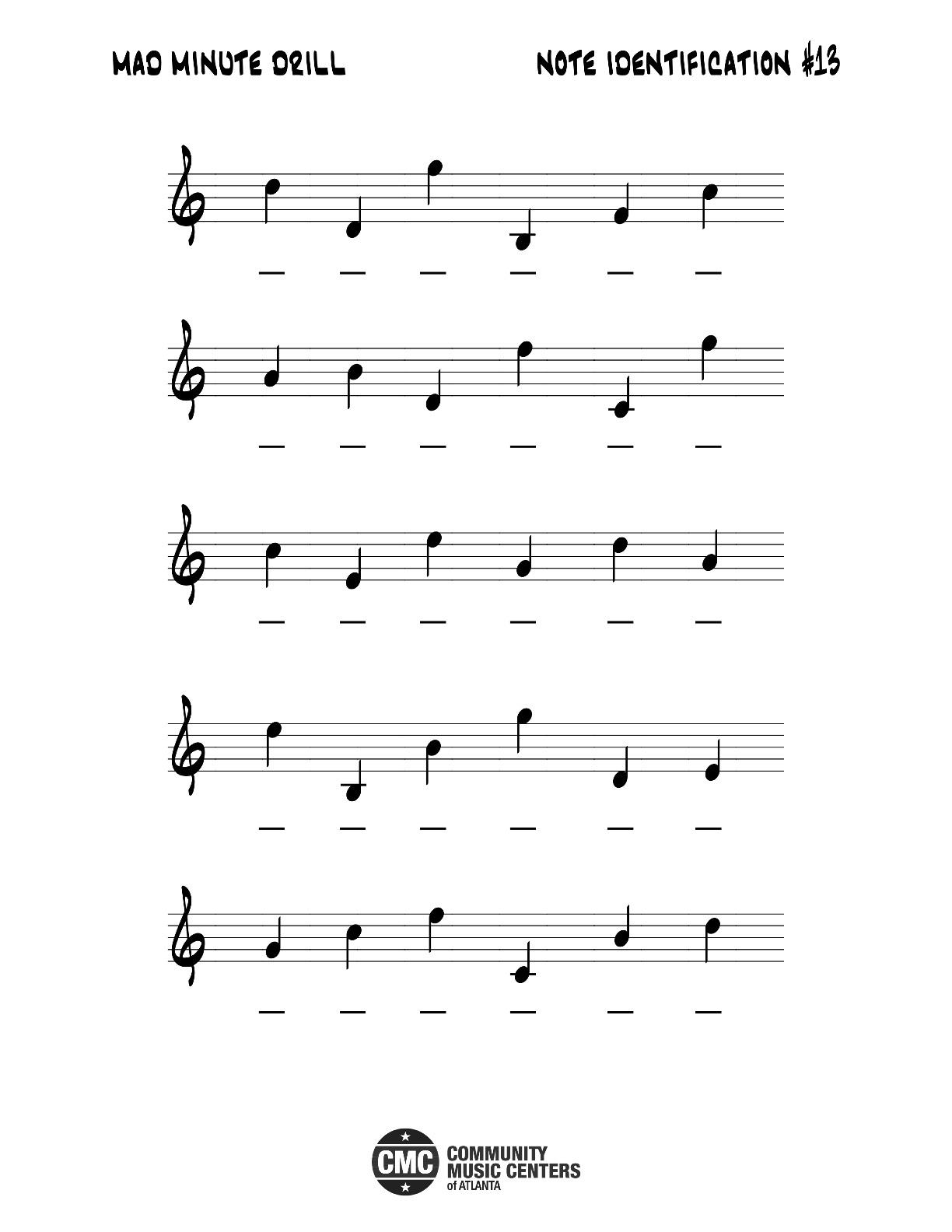
A couple of very basic tools are used in accomplishing the first few steps of learning to read. Flash card style drills, whether on paper, online or through an app, are a time honored approach to nailing down the critical fundamentals. We've posted some of the old school paper exercises we use with children. We call them Mad Minutes. Feel free to download, print, and self correct. If you want to send them back to us, you can share completed exercises with your teacher when you have your online lesson or you can send them back to the CMC Theory Gods, and we will grade them over for you.
We can also direct you to a couple of useful online tools or apps if you prefer to use a computer, pad or phone. Two very straight forward web sites with exercises for note reading, interval and chord reading are musictheory.net and teoria.com. These are straight forward flash card style exercises that are customizable. If you spend just a small bit of money, you can set up an account or download the app, save your settings and track progress. We recommend taking a very close look at the settings before starting exercises. For example, if you are working on note reading, you can set limits very tight at the outset and then gradually expand the boundaries as the student shows mastery. We often start beginners with the settingon treble clef in a very narrow range of 3 to 5 notes. When the student has shown both speed and accuracy, we broaden the range to an octive, or eight notes. Again, when mastery is evident, we open the range even further. Then we do the same with the bass clef, which we follow up with the full grand staff.
If you have questions about the Mad Minutes or the apps, please feel free to contact us via This email address is being protected from spambots. You need JavaScript enabled to view it.
Welcome to the Online Learning Portal
During the COVID-19 shutdowns, we've migrated activities from our facilities to the web, and we're posting our learning and training tools in a more public space so students and patrents can access them Oor goal is for current and new students to benefit from ongoing interaction with our faculty and one another during this period of social isolation. Social isolation does not equal musical isolation. We're getting started with some basics, but every day we'll be adding more information, lesson plans, links to useful resources and more. We'll also connect you with the faculty you know and love, which will bring welcome normalcy to somewhat
CMC Atlanta COVID-19 Update
Dear parents and students,
Thank you for your patience as we continue to explore how to respond to the latest developments and governmental recommendations to COVID-19. We want to be thoughtful in response to the latest information and updates, and ever mindful of needs and interests in our community. Doing our part to help blunt the spike in infections is important to us, and at the same time, we don't want to overreact and shut down completely when we could provide students and families meaningful and relatively safe experiences making music with us.
In short, we will be open this coming week, but we're placing some limits on in person programs involving groups, and we are opening the option for online engagement with us. If you know what you'd like to do already, please help us plan by completing the online COVID-19 Planning Form. If you'd like to know some details about our current plans and the logic informing our decisions, please feel free to continue reading.
Drum Camp - CMC Inman Park
July 5-8, 2022
8 am to 6:00 pm (Full Day) or 8 am to 12:30 pm, 12:30 to 6:00 pm (Half Day)
Drum Camp - CMC Sandy Springs
June 27-July 1, 2022
8 am to 6:00 pm (Full Day) or 8 am to 12:30 pm, 12:30 to 6:00 pm (Half Day)
Drum Camp - CMC Decatur
June 27-July 1, 2022
8 am to 6:00 pm (Full Day) or 8 am to 12:30 pm, 12:30 to 6:00 pm (Half Day)
Join the Horn Line
The Performance Workshop provides students the opportunity to play rock, jazz, pop, blues and more with peers. Students meet weekly during the school year and have the opportunity to immerse themselves in weeklong camps throughout the summer.
Program Director
Clayton Chastain: Trumpet
More info soon
Richard Williams: Horn
Richard Williams is a member of the Atlanta Ballet Orchestra, Artist-in Residence for horn at Kennesaw State University, host of the Atlanta Horn Chamber Music festival, and horn instructor at the prestigious Westminster Schools in Atlanta. He serves as a substitute musician for the Atlanta Symphony Orchestra and Atlanta Opera Orchestra. Richard has participated in the New Hampshire Music Festival and several recording sessions for video games as well as a major motion picture soundtrack. He also served as the long-term substitute principal horn of Symphony Orchestra Augusta for their 2014-2015 season. Richard frequently plays with the Huntsville and Chattanooga Symphony Orchestras and is fourth horn of the LaGrange Symphony Orchestra. For five years, he served as an adjunct faculty member at Columbus State University’s Schwob School of Music.
John Bryant: Trumpet
Dr. John Bryant is a native of Asheville, NC. He began his study of the trumpet at age 10 and has since studied with Kieg Garvin, Mark Clodfelter, John Rommel, Michael Tunnell, and James Ackley. John holds a Bachelor of Music degree from the Indiana University Jacobs School of Music, a Master of Music degree from the University of Louisville, and Doctor of Musical Arts from the University of South Carolina. In 2002, John made his Carnegie Hall solo debut at the age of eighteen. Since then, he has soloed with such groups as the St. Paul Chamber Orchestra , the Georgia Brass Band, Pan-Harmonia Chamber Music, the Keowee Chamber Players, Smokey Mountain Brass Band, the Blue Ridge Civic Orchestra, the Central Kentucky Concert Band, and others.
John has performed extensively in more than 30 states as well as many performances abroad in Europe and Asia. In 2008, John won the Naumann Trumpets Award for Artistry and 1st place at the National Trumpet Competition in the Reiche Baroque Solo Division playing a replica 18th century instrument. His performance positions include second trumpet with the Savannah Philharmonic Orchestra, second trumpet in The Atlanta Pops Orchestra, solo cornet with The Georgia Brass Band, and Mercury Orkestar.
In addition to being a well-known member of Atlanta’s freelance music scene, John also serves on faculty at Reinhardt University. John also teaches a private studio of students and is a member of the International Trumpet Guild. John is an endorsing College Teaching Artist for Torpedo Bags trumpet cases.
Bill Pritchard: Tuba
Bill is a native of New Jersey. He began teaching and freelancing in Atlanta in 2001 while he was a member of the Army Ground Forces Band. He currently plays tuba with the Midtown Brass Quintet, the acclaimed Georgia Brass Band, the New Atlanta Philharmonic, and the John's Creek Symphony Orchestra. In addition Bill plays sousaphone with The 4th Ward Afro- Klezmer Orchestra, Funk Cake and Mercury Orkestar. He has also performed with the Alabama, Columbus, Chattanooga, Macon, Cobb and Hilton Head Symphonies, the Savannah Philharmonic, the Atlanta Brass Society, The Atlanta Ballet and the Peachtree Brass.
As a soloist he has appeared with the Army Ground Forces Band, the New Atlanta Philharmonic, the Ludwig Symphony, and the New Jersey-based South Orange Symphony, delighting audiences of all ages with his dynamic interpretations of both standard and lesser known works for tuba. Bill has a project of free improvisations with amplified tuba with effects and loops called Amplituba. He has played as Amplituba at regional and international brass festivals, rock clubs and released a self titled album.
In addition to his performance schedule, Mr. Pritchard is a dedicated teacher of his craft, giving private lessons and master classes on euphonium and trombone, as well as the Low Brass professor at Georgia College and State University and Lee University. Bill holds a Bachelor of Arts degree in music management from William Paterson University and a Master of Arts in classical performance from the Eastman School of Music.
Bill is an Artist for the Eastman Music Company and Parker Mouthpieces.
Hollie Lawing: Trombone
Hollie Lawing graduated with her B.M. in Music Performance from Georgia State University and did her graduate studies at the acclaimed Cleveland Institute of Music. As a performer, Hollie has played with the Atlanta Symphony Orchestra, Atlanta Opera Orchestra, Atlanta Ballet Orchestra, as well as the Savannah Philharmonic, Hilton Head Symphony, Johns Creek Symphony, Columbus Symphony, Macon Symphony, and the Augusta Symphony, among others. She has been Principal trombonist with the Carla Rosa Opera Company U.S. Tour, the Sigmund Romberg Tour, and has performed on several occasions with the Atlanta Pops Orchestra, including a four-week tour to Taiwan. Hollie is a founding member and Trombonist with the Midtown Brass and also plays Principal Trombone with the Georgia Brass Band. In 2014 she played solo Trombone with the DIVA big band in the show "Maurice Hines is Tappn' thru life" in a 5 week run, presented by the Alliance Theatre.
In 2017, Hollie performed at the International Women's Brass Conference with the Athena Brass Band.
Hollie is adjunct instructor of trombone at Mercer University and Reinhardt University and maintains a private studio of trombone at Lassiter High School in Cobb County, as well as a studio in her home in Marietta, Ga.
Jason Casanova: Euphonium
A native of San Antonio, Texas, Jason Casanova brings his southwestern flair to the southeast. He is in high demand as both a performer and teacher of euphonium and low brass throughout the region. He holds degrees from Georgia State University in Atlanta, GA and St. Mary’s University in San Antonio, TX.
As a solo performer, Jason has won or placed in many regional, national, and international euphonium solo and chamber competitions including the Leonard Falcone Festival International Euphonium and Tuba Competition and both the the International Euphonium Institute's solo and duet competitions. In terms of ensemble performance, he is Solo Euphonium with the Georgia Brass Band, a founding member of Divergence (a tuba/euphonium quartet), and also plays with other diverse ensembles such as the 4th Ward Afro-Klezmer Orchestra (performing music from traditional Klezmer music to Frank Zappa), and Mercury Orkestar (an ensemble that performs a fusion of traditional Balkan tunes fused with modern western pop music). In addition to performing and teaching, Jason is also an experienced music arranger. His arrangement of the “Serenade from the Student Prince,” was recently published by Euphonium.com Publications with several more on the way.
Jason teaches euphonium at Georgia State University in Atlanta, Georgia, Kennesaw State University in Kennesaw, Georgia, and Jacksonville State University in Jacksonville, Alabama, as well as maintaining a successful private studio at Lassiter High School in Marietta, Georgia.
In addition to teaching at the Workshop & Festival, Jason is the program coordinator and director.
Wizards Music Academy - CMC Sandy Springs
Guitar & Ukelele Camp - CMC Inman Park
Guitar & Ukelele Camp 1 - CMC Decatur
Guitar & Ukelele Camp - CMC Sandy Springs
Dr. Matthew Brower
Dr. Matthew Brower is the CMC Atlanta Piano Program Chair. Matt is a Nationally Certified Teacher of Music through the Music Teachers National Association. With over fifteen years of experience teaching students ranging from beginner to undergraduate music majors, he enjoys teaching classical and jazz, and one of his students was recently honored to perform at Carnegie Hall as a prize winner of the American Protégé International Piano & Strings Competition. Matt has performed with the Chamber Orchestra of Philadelphia as well as members of the Philadelphia Orchestra, the Baltimore Symphony Orchestra, and faculty from many leading conservatories. Matt is also an Artist Affiliate faculty member at Emory University. He received his Doctor of Musical Arts and Master of Music degree from the University of Michigan, and his Bachelor of Music degree from the Oberlin Conservatory of Music.
Alex @ Variety Playhouse
Luca @ Variety Playhouse
John Cage
One of my favorites
We Are the Champions, Queen
Happy Together, The Turtles
With a Little Help from My Friends, The Beatles
California Dreamin', The Mamas & The Papas
Upside Down, Jack Johnson
Music Boot Camp - CMC Inman Park
Music Boot Camp - CMC Sandy Springs
Schoolhouse Rock - CMC Inman Park
Schoolhouse Rock - CMC Decatur
Student Showcase @ Variety Playhouse

It's official! Friday, July 11 we're hosting a Student Showcase at the Variety Playhouse in Little 5 Points. The 8 pm show will feature an intergenerational line up students, faculty, alumni, alumnae, and friends performing a mix of jazz, rock and roots standards, covers and originals. This is an incredible opportunity to be part of a fun show we're producing ourselves at Atlanta's best music venue! Best of all, through participating in or coming to the Showcase young performers and audience will be supporting our outreach to under-resourced youth.
Diana Orozco

Diana Orozco is an accomplished music educator and administrator with nearly 20 years of leadership experience and over 30 years as a dedicated teacher. A graduate of the Oberlin College-Conservatory, Diana has shaped music programs in schools, workshops, and summer camps throughout Atlanta. She served as the pre-primary through 6th grade music teacher at The Children’s School in Midtown from 2000 to 2013, and before establishing Community Music Centers of Atlanta, she maintained a thriving private piano studio. While much of her work has focused on elementary education, Diana also enjoys teaching high school and gap year students, mentoring new teachers, and designing engaging music curricula. She is passionate about fostering wellness and empowerment through music, ensuring students of all ages gain confidence, creativity, and a lifelong connection to the arts. Diana is committed to guiding students and fellow educators alike, building an inclusive and inspiring environment where music learners can thrive. When not playing the piano, Diana can be found hanging out with her dog Milo and visiting her adult daughters in LA and Martha's Vineyard.
Jedi Music Academy - CMC Sandy Springs
Winter Weather Closures and Make Up Days
The weather forecast suggests there could be more snow and ice across metro Atlanta this week, and most schools have closed in response. We always post local Center and program closures on our web site. Please check back for updates. Our general rule of thumb is to follow the local school calendar, unless circumstances warrant otherwise.
We are tracking the history of school and related CMC Atlanta program closures this term, and we will post make up options for missed lessons and AMP days as it becomes clear how school districts will adjust their calendars in response to this winter's unusual number of winter weather related interruptions.
Folk, Country & Roots : Decatur
Folk, Country & Roots : L5P
Music Theater Camp - Sandy Springs
Schoolhouse Rock - CMC Sandy Springs
School Closed? Workshops for Students
During the winter months local schools occasionally close due to snow, ice or cold. When schools are closed, it sometimes makes sense for us to offer a Day Camp Workshop. These workshops provide coverage for moms and dads who either want or need it. We can almost always provide this service when the main danger to student welfare is exposure to extreme cold and wind. (Moms and dads bring students by car directly to us from door-to-door, so no one is likely in jeopardy of exposure.) We are less likely to offer the service if schools are closed due to icy or snow-covered roads or widespread power outages.
When schools close, AMP and Core program lessons at the local CMC Atlanta facility are cancelled for the day. Please note: closures affect only the district for the neighborhood CMC location. For example, CMC Decatur closes when CSD close; a CSD closure does not affect programming in Little 5 Points or Dunwoody.
Wand Making
Students create their own wands by decorating bamboo sticks or
make a wand out of paper and glue
http://www.instructables.com/id/Make-an-awesome-Harry-Potter-wand-from-a-sheet-of-/
Bibbidy-Bobbidy Boo
Bibbidi Bobbidi Boo
Legos and glue and magic wands too
Bibbidi bobbidi boo
Put them together and what have you got?
Bibbidi bobbidi boo
Potions and brooms and Quidditch balls too
Bibbidi bobbidi boo
It will do magic believe it or not
Bibbidi bobbidi boo
From ashes the Phoenix flies
and rises high in the sky
The Hogwarts Express is coming in soon
Bibbidi bobbidi boo
Technics Digital SX-PX 222
Beehive Cold Beverage Dispensers
Norton Anthology of Western Music (volume 1)
Jason Cassanova
Information coming soon.
Phil Sims
Phil Sims studied music at the undergraduate and graduate level at the Eastman School of Music in Rochester, NY. He has held academic appointments to teach a variety of courses ranging from music theory, musicianship, to composition and electronic music in a number of different colleges, specifically the Eastman School of Music, the University of Rochester, Mercer University, and Emory University. In recent years, Phil’s creative work has mainly focused on the creation of albums and sound design scores using a mix of acoustic and virtual instruments. His compositions have been performed and presented throughout the country and in Europe, in both academic and community venues, most recently at the Schwartz Center on the Emory University campus, the Ferst Center at Georgia Tech, the Atlanta Ballet’s Centre for Dance Education, Eyedrum, during the 2010 Dodekapus Art Collective Carnival, the 2010 L5P Halloween Festival (in collaboration with gloATL lab), and more. His intellectual and academic essays have focused on theoretical and pedagogical issues ranging from integrated and experiential instruction to sociopolitical topics like musical rhetoric, the politics of beauty, including the friction between expertise and populism in music, modes of listening, and the practice of aesthetic apartheid within academic departments and curricula. Current research includes a deep dive into music cosmology, especially three dimensional modeling of musical spaces and the nature of time and its impact on or exploration through musical practice.
As an undergrad, Phil played in the famed Eastman Wind Ensemble, Eastman Philharmonic, Musica Nova, and the Eastman Trombone Choir. Phil continued playing in a variety of new music and chamber music ensembles until about 2010, including several years as the trombonist in Colony IV, the Mercer University faculty brass quintet.
Phil began lecturing in music theory over 20 years ago at the Eastman School, at the age of 22; while a grad student at Eastman, he won both the School’s graduate student teaching award and the University of Rochester’s Edward Curtis Peck Award for excellence in undergraduate instruction. Phil was also the recipient of the Presser Award to fund musicological research on the music of Erik Satie at the Bibliotheque National in Paris.
In addition to pursuing inspired, effective teaching from an academic platform, Phil has also collaborated in a variety of music and education projects with organizations like the Atlanta Ballet, FOCUS (Families of Children Under Stress), the San Francisco Bay Chapter of the American Composers Forum, the Atlanta Girls’ School, and the Montessori School at Emory, to name a few. In 1998, Phil helped direct an album of Christmas music and spirituals performed by clients of the Atlanta Union Mission at Haygood Memorial UMC in the Morningside neighborhood of Atlanta. The album was distributed and sold ny the Union Mission with proceeds used to support the client's rehabilitation, housing, medical and other needs.
Founding and Directing the Community Music Centers represents both the culmination of his career to date and an exciting set of new opportunities for Phil to teach and create from a completely independent platform. It was also the fulfillment of a long held dream he shared with co-Founder and Director, Diana Orozco, and one of the ways Phil marked his 40th birthday.
Phil's educational ideas and methods impact all CMC Atlanta students through the Administrative role he plays in designing and implementing CMC programs and curricula. His private composition students have enrolled in collegiate composition and sound programs around the country after their high school graduation, including a recent graduate who enrolled to study with Pulitzer Prize winning composers in New York City and others sent to study sound design at the Cleveland Institute of Music, Berklee College of Music, Lamont School of Music in Denver, and the School of the Art Institute of Chicago.
Diana Orozco

Diana Orozco is an accomplished music educator and administrator with nearly 20 years of leadership experience and over 30 years as a dedicated teacher. She attended Oberlin College Conservatory and has shaped music programs in schools, workshops, and summer camps throughout Atlanta. Diana served as the pre-primary through 6th grade music teacher at The Children’s School in Midtown from 2000 to 2013, and before establishing Community Music Centers of Atlanta, she maintained a thriving private piano studio. While much of her work has focused on elementary education, Diana also enjoys teaching high school and gap year students, mentoring new teachers, and designing engaging music curricula. She is passionate about fostering wellness and empowerment through music, ensuring students of all ages gain confidence, creativity, and a lifelong connection to the arts. Diana is committed to guiding students and fellow educators alike, building an inclusive and inspiring environment where music learners can thrive. When not playing the piano, Diana can be found hanging out with her dog Milo and visiting her adult daughters in LA and Martha's Vineyard.